What it is
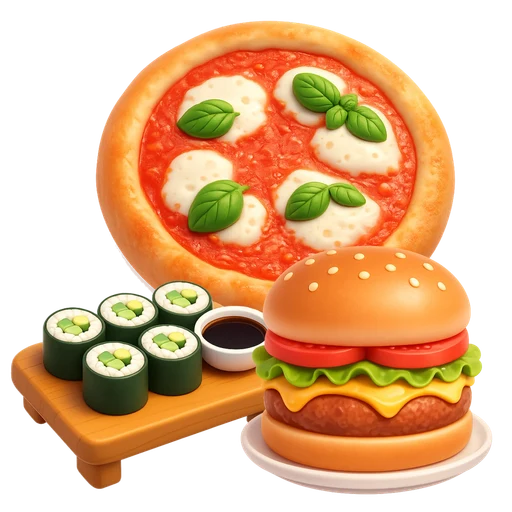
Tiny Kitchen is a cooking game where children make real dishes the way they're really made. They pick a dish from a menu of twelve dishes from ten countries: a margherita pizza from Italy, chana masala from India, mie goreng from Indonesia, veggie sushi and tuna nigiri from Japan, dumplings from China, a burger from America, lasagne from Italy, paella from Spain, crêpes from France, a meat pie from Australia and a Greek salad. Each dish has its country's flag, the vegetarian ones have a little leaf, and on a big screen the menu is a world map, with each dish next to the country it comes from. Every dish is made step by step, with the child's own hands on screen. They find the right ingredients on the shelf (a banana doesn't go in pizza dough, and it bounces back gently), then knead the dough, chop the onion with a child-safe knife, stir the pot, roll the sushi, fold each dumpling closed and layer the lasagne three times. When a dish goes in the oven, a grown-up does it: ovens are hot. Biscuit talks them through every step and shares a fun fact along the way: soffritto means "gently fried" in Italian, turmeric is what makes curry yellow, and in Australia ketchup is called tomato sauce. When the dish is ready, Biscuit carries it to a friend's table: Momo, Penny, Lulu, Bubba, Otto or Rio, who eats it bite by bite. There's no score, no timer and no way to fail, and every dish is open from the start. It suits preschoolers and kids in the first years of school, ages 3 to 7.
How to play
On a laptop or desktop
Click a dish on the menu to start. Click the glowing things to use them, or drag them where they go: an ingredient into the bowl, the sauce onto the pizza, the dish into the oven. Arrows show what to do: round and round to stir, tap tap tap to chop and knead, side to side to roll. When the oven glows, click it.
On a tablet or phone
Tap a dish to start. Tap what glows, or drag it where it goes. Follow the arrows: rub in circles to stir, tap to chop and knead, swipe side to side to roll. Tap the glowing oven to bake.
What children learn
- Following steps in order: you knead before you roll and roll before you bake, as in a real recipe
- Ingredient words: yeast, chickpeas, nori, celery, béchamel, oregano
- Where food comes from: twelve dishes from ten countries, each with its flag, on a world map
- How cooking works: dough rises because of the yeast, rice drinks up the stock, steam cooks dumplings
- Counting and fine motor skills: three layers, four dumplings, slicing, stirring, folding
Tips for parents
Cook one of the dishes for real afterwards. Pizza, Greek salad and crêpes are easy with a child, and they'll already know the steps. Ask "what comes next?" before Biscuit says it. Find the countries on a map or a globe. If a dish is one your family makes, tell them how you make it at home: it's a good start to a conversation about family recipes.
Questions parents ask
Are there vegetarian dishes?
Yes. Five of the twelve are vegetarian (pizza, chana masala, mie goreng, veggie sushi and Greek salad) and have a leaf on the menu. They have no meat, fish or eggs. The other dishes are made the classic way.
Does my child use a real knife or the oven?
In the game, children slice with a rounded, child-safe knife, as they could in a real kitchen with a grown-up. The oven is always done by a grown-up, and Biscuit says ovens are hot and a grown-up helps.
Is there a score or a time limit?
No. There's no timer and no way to fail. A wrong ingredient just bounces back to the shelf, and help only shows after a miss.
Does it need reading?
No. Biscuit says every step aloud, and arrows and glowing things show what to do.